


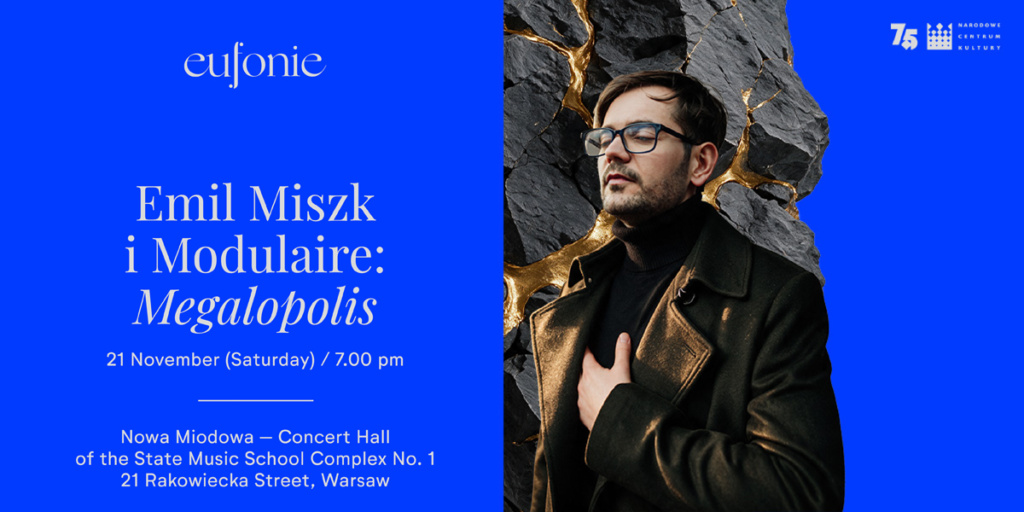
Emil Miszk i Modulaire
2026-09-23
Emil Miszk is a versatile artist – trumpeter, composer, arranger, and Fryderyk Award winner – who does not limit himself to one predetermined path. In his activities, he freely combines genres as distant as early music and jazz. Moreover, he is always open to new encounters and inspirations, which have resulted in numerous recordings and concert tours. One of his new concert projects is Megalopolis – a musical vision of a city that becomes a metaphor for structure, experience, and interpersonal relationships.
These are eight substantial compositions, written and arranged by Emil Miszk. They were recorded on an album by an ensemble consisting of renowned international artists. It brings together both musicians who can boast significant achievements in the field of jazz and those who – having shared the stage with the project’s originator for years – have a need to explore new territories. The name of the formation, Modulaire, is not accidental: the premise of the project is to perform the works in various, smaller configurations of musicians, which the composer calls modules. A total of sixteen musicians participated in the recording, but at concerts they can perform in a much smaller group, even in single-digit numbers. This creates an opportunity to seek out novelty, modify the works performed, and build new musical relationships within the ensemble.
As Emil Miszk says, Megalopolis was created out of the need to describe a world in which complexity has become an everyday reality, and simple forms are no longer enough.1 Hence, there is no permanent ensemble, and the works have a partially open form. The composer left empty spaces in them, which he describes as ‘fields of possibility’. Each of the musicians can fill them with their own content, which changes depending on the day, the mood, the energy of the audience, and even the venue’s acoustics. These are not traditional jazz ‘solos’, but instances of collective improvisation that can turn into a solo, with any instrument taking the lead. It is here that space is created for decisions, reactions, and listening to each other. Here, the metaphor of a city is fulfilled, in which each voice has its own function, but its meaning is born and crystallised only in relation to the others. In addition to the instrumentalists, one of the members of the ensemble is also a singer, who appears on the album in two compositions. His part, with a text inspired by haiku and Horace’s poetry, follows the music.
Megalopolis cannot be classified within one musical genre. Jazz meets improvisation, contemporary classical music, and film music, creating a complex and multi-layered organism. Emil Miszk notes that the city is not a homogeneous structure – each district looks different; its inhabitants have different routines and tastes.2 Their everyday experience is learning to live together: listening to each other, passing each other, responding, giving way, but also making their own voices heard. The diverse, heterogeneous instrumentation of the Modulaire formation can be interpreted as a metaphor for the diversity of the city’s inhabitants. Contrasts release energy, and sudden twists and turns in the musical action are possible thanks to precision, a sense of humour, and an awareness of the tension between a given composition and its performance.
The concept of Megalopolis grows out of thinking of the city as a living organism – a space of community, tension, and polyphony. It is a project about how we live today: amid an excess of stimuli, roles, and expectations, and at the same time with a need for mindfulness and co-responsibility. Observing the musicians on stage, one can be tempted to reflect on how many independent voices can coexist. Sometimes in tension, sometimes in agreement, sometimes only for a moment.
Is a monolith more attractive than a whole glued together from small pieces, each of which has a different shape? What inspires and stimulates the imagination more: a form thought out in every detail or one that leaves room for understatement? The answer may lie in the person of the creator. In order for a work of art to delight, it must come from the master’s hand. In Emil Miszk’s metaphorical city, there is space for a creative act that takes place in front of the audience, each time bringing a different result. Curiosity about the outcome allows us to accept the fragility of the matter and see in it an opportunity to create something new. Art is sometimes the only space for understanding when words fail. At the same time, in order to exist, it needs a stimulus that gives it meaning. The roots of Megalopolis are undoubtedly the challenges of everyday life, which provide us with an opportunity to learn to live better every day.
The National Center for Culture is the organizer of the event. The event’s partner is the Baltic Sea Cultural Center
in Gdańsk.
Concert details and programme:
Emil Miszk and Modulaire: Megalopolis
21 November, 2026
7:00 p.m.
Nowa Miodowa, Warsaw