


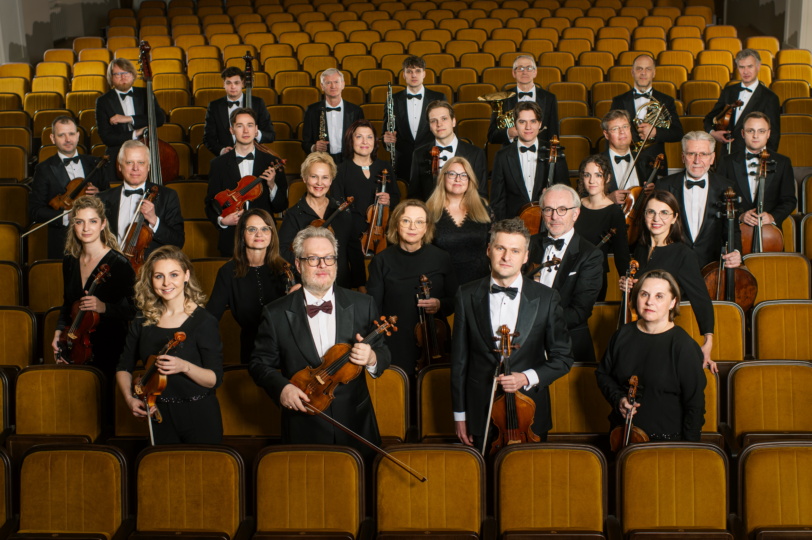
The Lithuanian Chamber Orchestra (LCO, founded in 1960 by Professor Saulius Sondeckis) is recognised as one of the finest and most internationally acclaimed Lithuanian orchestras. On the 23rd of April 1960, the LCO began rehearsing as a new formation and invited to its first public concert on the 30th of October the same year to gain instant recognition among the audiences and critics both at home and abroad.
Having formed an orchestra and embarked on tailoring the collective’s individual voice and repertoire Prof. Sondeckis started exploring new niches for its activity. Gradually these creative aspirations grew into dynamic traditions of cultural life in Lithuania. New Year Eve concerts at the Vilnius Cathedral (then the Painting Gallery), launched on 31st December 1966, gained special popularity. “Farewell to Old Year” concerts at St. Johns’ Church in Vilnius featuring Haydn’s Abschiedssinfonie (Farewell Symphony) are gathering numbers of connoisseurs to this day: for over 50 years the Lithuanian Chamber Orchestra has been performing the legendary opus in a vanishing candlelight.
In 1967, the orchestra was the first to organise concert series in a newly restored Trakai Castle. Inaugurated in 1971, “Nakties serenados” (Night Serenades) on the terrace of Amber Museum in Palanga were the LCO’s hallmark drawing thousands of holidaymakers.
The LCO became the first Lithuanian orchestra to receive an official permission to tour outside the Soviet Union: in 1966, it gave two concerts in the then German Democratic Republic. The young and energetic group of Lithuania’s finest string players was instantly noticed by both music record companies and festival organisers alike. Yet more intense advance towards the international music scene began a decade later, in 1976, when the LCO appeared at the Echternach festival in Luxembourg to great critical acclaim. The orchestra participated in this festival seven times and was awarded the Great Lion medal.
Over the years tour itineraries of the LCO, an ambassador of Lithuanian music culture, have covered the length and breadth of Europe, reached both Americas, Cuba, Egypt, the Republic of South Africa, the United Arab Emirates, Australia, Taiwan, Japan, China, Costa Rica and Lebanon. It has been many times applauded at the Berlin Philharmonic, Vienna’s Musikverein, London’s Royal Festival Hall, Rome’s Accademia Nazionale di Santa Cecilia, Amsterdam’s Concertgebouw, Salle Pleyel and Gaveau in Paris, Leipzig’s Gewandhaus to name but a few celebrated concert halls.
Among the many world-celebrated masters of the baton who stood at the helm of the LCO, the legendary humanist Sir Yehudi Menuhin stands out. From the first rehearsals of Handel’s Messiah in Spain in 1992 to his death in 1999, he annually conducted the LCO in various countries. Maestro led the orchestra in almost 60 concerts, recorded three CDs: Handel’s Messiah, Haydn’s Die Schöpfung (The Creation) and Schubert’s Mass No. 4 and Mass No. 5 (released on Apex).
The LCO has repeatedly collaborated with such distinguished performers as violinists Gidon Kremer, Janine Jansen, Julian Rachlin, Boris Brovtsyn, Hugo Ticciati, Gil Shaham and Daniel Hope; cellists Mstislav Rostropovich, David Geringas, Mischa Maisky, Danjulo Ishizaka and Denis Shapovalov; violists Hartmut Rohde and Maxim Rysanov; pianists Mūza Rubackytė, Andrius Žlabys, Lukas Geniušas, Evgeny Kissin, Barry Douglas, Jean-François Heisser, Reinis Zariņš, Dmitry Bashkirov, Vladimir Krainev, and Alexei Volodin; trumpetists Timofei Dokschitzer, Guy Touvron and Sergei Nakariakov; flutists Jean Pierre Rampal, Denis Bouriakov and Massimo Mercelli; oboist Alexei Ogrintchouk; composer and pianist Ezio Bosso and many others. The collective has collaborated with conductors Modestas Pitrėnas, Robertas Šervenikas, Modestas Barkauskas, Vilmantas Kaliūnas, Adrija Čepaitė, Nicholas Milton, Georg Mark, Ronald Zollman, Pietro Borgonovo, Christian Frattima, Benjamin Haemhouts, Michał Dworzyński, Ernest Hoetzl, Andrzej Kosendiak, etc.
The orchestra collaborates with renowned soloists, conductors and choirs not only in countless concerts, but also many times in the recording studio. They have recorded more than 100 vinyl and CDs in a wide range of repertoire, with a particular focus on the works of Bach and Mozart. The latter’s output occupies a special place in the LCO’s repertoire: the orchestra has recorded all of his symphonies and the opera Don Giovanni (Melodiya), performed all instrumental concertos. The staged production of the opera Così fan tutte (Women are Like That) at the Lithuanian National Philharmonic Hall as part of Vilnius Festival 1998 has received accolades from both audience and critics alike. The LCO’s repertoire includes Bach’s instrumental concertos, suites, passions and numerous cantatas; Great Mass was performed in Lithuania, France, Spain, Italy and many other European countries. Memorable were the LCO’s concert tours in Germany with the famous British actor Peter Ustinov: excerpts from Beethoven’s music for the ballet The Creatures of Prometheus were performed with the actor reciting the texts. The CD Beethoven’s “The Creatures of Prometheus”, recorded with him and conductor Karl Anton Rickenbacher, turned out to be one of BMG’s best-sellers. Following the orchestra’s tour of Japan with the renowned trumpeter Sergei Nakariakov, an album of transcriptions of the Hummel, Mozart, Weber and Saint-Saëns concertos for solo trumpet and chamber orchestra, Echoes from the Past (Teldec Classics, 2002), was released receiving 5 stars in the Classic CD category.
In 2016, the world’s classical record leader Deutsche Grammophon released the CD of the Lithuanian collective (for the first time!) featuring LCO and Sergej Krylov in Vivaldi’s The Four Seasons as well as concertos No. 8 and No. 9 for violin and strings. With this CD the LCO became the first Lithuanian collective to enter the world’s classical music elite. 2024 saw one more release – a CD of works by J.S. Bach recorded by the LCO, S. Krylov and E. Bosso.
Along with performances of baroque and classical masterpieces, the orchestra frequently includes contemporary opuses in its concert programmes and recordings. It has always been an active promoter of Lithuanian music, having performed works by Mikalojus Konstantinas Čiurlionis, Eduardas Balsys, Julius Juzeliūnas, Osvaldas Balakauskas, Teisutis Makačinas, Jonas Tamulionis, Algirdas Martinaitis, Vidmantas Bartulis, Mindaugas Urbaitis, Arvydas Malcys, Raminta Šerkšnytė, Justė Janulytė, Loreta Narvilaitė, Žibuoklė Martinaitytė and Ramūnas Motiekaitis.
The orchestra has performed the programme Freedom of the Baltics in Lithuania and Estonia to celebrate the 100th anniversary of the restoration of statehood of Baltic and represented the 100th anniversary of the restoration of the Lithuanian State in a gala concert together with pianist Mūza Rubackytė and conductor Robertas Šervenikas in Paris’ Gaveau Hall.
Today the LCO not only keeps the high standard of artistic excellence but also ardently explores new creative resources presenting original programmes. “The Lithuanian Chamber Orchestra is like the finest quality instrument, having the distinctive sound and tradition of performance. I rank this orchestra among the leaders of the genre. Sixty years is a long history. Not so many orchestras in Europe can pride themselves on such glorious past,” says violinist Sergej Krylov who has been appointed the artistic director of the LCO in December 2008, after several successful appearances at the National Philharmonic in Vilnius. His broad purview and contacts in the musical world, as well as polished musicianship, professional experience and his talent raised the LCO to the next professional level. The critics have not spared accolades in describing a dynamic musical partnership between the orchestra and its leader: “an absolute attunement between the violinist-conductor and the orchestra,” “the charming noble gallantry, without improper familiarity, but with confidence in each other.” (atgimimas.lt)